Clickbait Theory: Why MrBeast is Doomed to Fail
The TL;DR
- MrBeast has perfected the YouTube game: bigger budgets, crazier stunts, more views
- But the data shows something worrying: each dollar buys fewer views than before
- The more you spend on spectacle, the more you have to spend next time just to keep people interested
- The model that made MrBeast the biggest creator on earth might be the very thing that traps him
The Most Successful Content Machine in History
Jimmy Donaldson, better known as MrBeast, is the biggest YouTuber on the planet. His videos routinely hit 100 million views. His production budgets have climbed into the millions. He gives away private jets, builds replica Squid Games, and buries people alive for content.
It’s easy to look at this and think: this is the future of content. More production value, higher stakes, bigger spectacle.
But what if MrBeast’s model is already past its peak?
The Problem: Views Per Dollar
As MrBeast’s budgets have grown, the efficiency of his spending has collapsed.
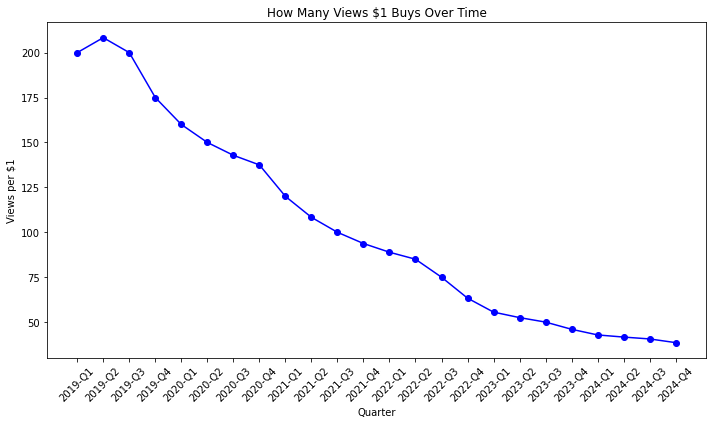
This chart tells the story. In the early days, a dollar of production could buy you thousands of views. Today? A fraction of that. Every new video needs to be bigger, more expensive, more elaborate to move the needle the same amount.
This is the diminishing returns problem. The audience gets used to a certain level of spectacle. A $100,000 video was shocking in 2019. In 2024, you scroll past it. So you spend $500,000. Then $1 million. Then $2 million. The treadmill never stops. It just gets faster.
The Physics of Attention
Three forces are working against the escalation model.
Attention is finite. People only have so much mental bandwidth. When you’re constantly hit with bigger, louder content, you stop noticing. The content doesn’t get worse. Your brain just gets full.
Desensitization is real. The first time you see someone give away a house, it’s shocking. The tenth time? It’s Tuesday. Repeated exposure to high-intensity stimuli makes them feel normal. To get the same reaction, you have to go bigger. Always bigger.
The algorithm is shifting. YouTube’s recommendation engine isn’t what it was five years ago. It increasingly rewards authentic, personality-driven content over high-production spectacles. The platform is maturing. What worked in 2020 may not work in 2026.
What Beats MrBeast Won’t Look Like MrBeast
The creators who win the next era of YouTube will be the ones who build genuine connection over manufactured spectacle. The ones who make you care about their life, their perspective, their voice. Not just their budget.
Authenticity scales. Spectacle doesn’t.
MrBeast built an empire on the principle that more is more. But more has a cost, literally. And at some point, the math stops working.
“In our relentless pursuit of spectacle, we risk devaluing the very currency of attention—a resource too finite to be endlessly exploited.”